
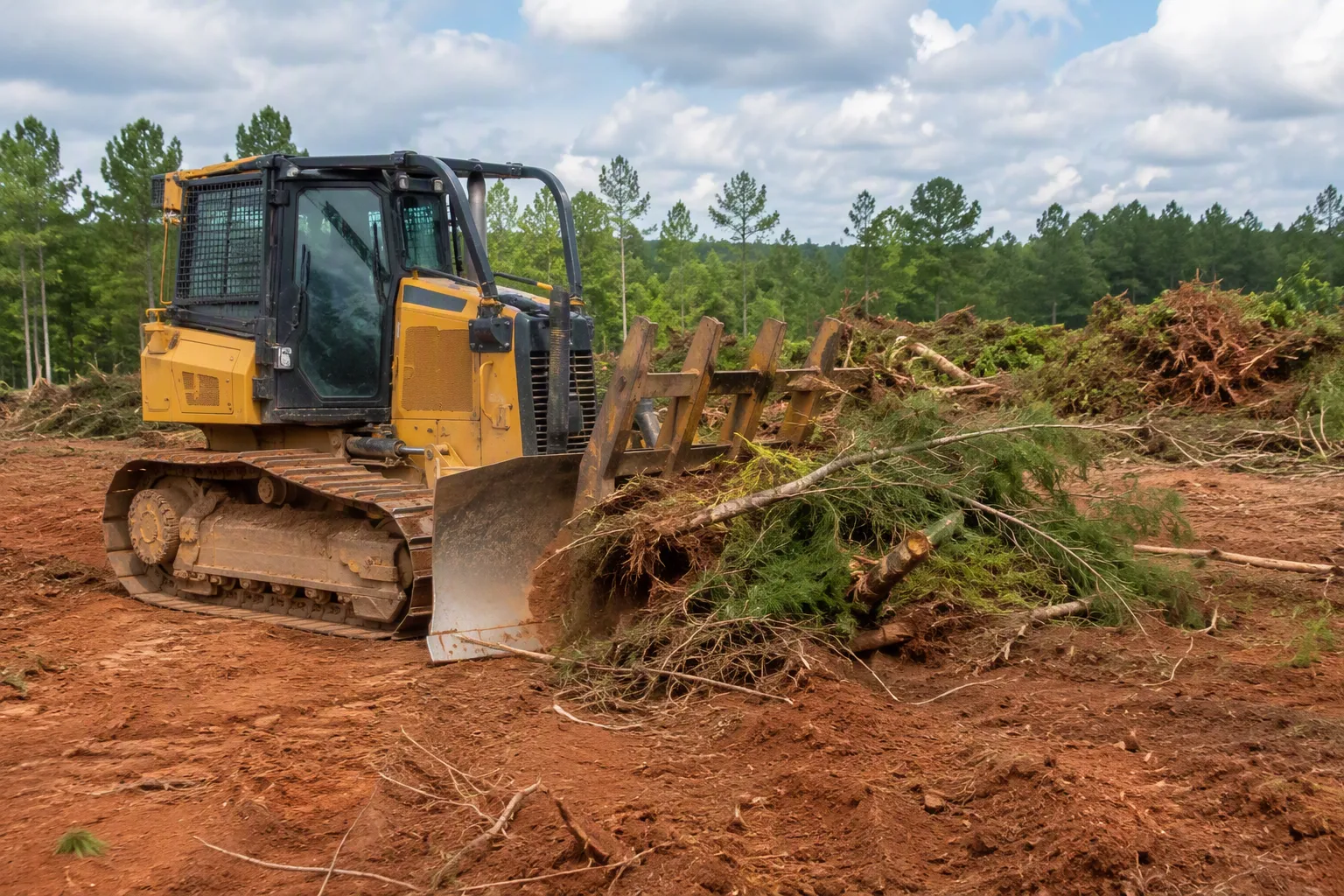
Brush Removal in Raleigh, NC

When Brush Takes Over, We Take It Back

In Wake County, brush doesn’t wait. North Carolina’s long growing season — hot,
humid summers that stretch well into October — gives invasive vines, woody
shrubs, and opportunistic undergrowth the time they need to reclaim fence lines,
pasture edges, and forgotten corners of your property in a single season. Land
ClearCo provides brush removal services throughout Raleigh, Wake County, and
the surrounding Triangle area, using the CAT 275 XE forestry mulcher to restore
property edges, open access through overgrown land, and clear brush that hand
tools can’t touch.

Why Brush Grows Back So Fast on Triangle-Area Properties

Wake County’s climate is ideal for the kind of plants you don’t want. Long frost-
free windows, abundant summer rainfall, and clay-based soils that hold moisture
create conditions where invasive shrubs, aggressive vines, and fast-growing
native volunteers can put on several feet of growth in a single season. Property
edges and fence lines that get skipped for a few years don’t just look rough —
they become structurally impenetrable. Once vines start climbing, the root
systems expand underground, and hand-cutting the tops barely slows the overall
spread.

Common brush removal situations we encounter across Raleigh and Wake
County include:

Chinese Privet Along Fence Lines and Wooded Edges

Ligustrum sinense is one of the most common invasive shrubs throughout the Triangle. It spreads by seed and produces dense multi-stemmed thickets that can reach fifteen feet or more in height. It grows in sun or shade, thrives in clay soils, and re-sprouts from the root crown after cutting — making it extremely persistent without the right equipment to process the root mass.

Kudzu on Road Banks and Property Borders

Kudzu can grow up to a foot per day during North Carolina’s summer months. It smothers everything it contacts — trees, fences, outbuildings, and neighboring vegetation — and the massive tuberous root system makes it extremely difficult to eliminate without aggressive mechanical removal.

Wisteria Overtaking Trees and Structures

Invasive wisteria — particularly Japanese wisteria — twists around tree trunks and structural fencing with enough force to eventually damage or kill the host. It spreads by both root runners and seed, and colonies that have been established for several seasons can anchor themselves in ways that are nearly impossible to clear by hand.

Japanese Honeysuckle and Common Greenbrier Tangles

These two vines frequently grow together across Wake County’s woodland edges and fence lines. Japanese honeysuckle spreads aggressively and blankets the understory. Common Greenbrier (Smilax rotundifolia) adds thorned woody stems and underground rhizomes to the mix, creating tangled masses that make the land physically unusable.

Overgrown Pasture Edges and Hunting Land Access

Pastures that aren’t actively managed at the edges will lose acreage to woody encroachment every year. Similarly, hunting property access points, food plot edges, and trail corridors on rural Wake County parcels get reclaimed by brush faster than most landowners expect. Raleigh’s growing season is long enough that brush re-establishment after a previous clearing attempt can be nearly complete within two years. That’s the reality of land management in this part of North Carolina.

How Land ClearCo Handles Brush Removal

We don’t use hand crews with chainsaws and loppers for brush removal — those tools can’t keep pace with established invasive thickets at any meaningful scale. The CAT 275 XE forestry mulcher processes brush, vines, shrubs, and small trees in a single pass, mulching the material on-site and eliminating the debris pile, the haul cost, and the multiple-visit problem entirely. With 46% more horsepower than a Bobcat T770 and 34% more than a John Deere 333G, the CAT 275 XE doesn’t stall on dense woody privet stands or thick greenbrier mats — it works through them continuously. That matters when you’re clearing a long fence line or a property edge where productivity per hour directly determines cost.

What Wake County’s Clay Soils Mean for Brush Removal

When brush removal exposes bare soil — as it does with conventional methods —
Wake County’s clay-based soils present an immediate erosion risk. Clay sheds
water rather than absorbing it, and bare cleared edges on sloped or low-lying
ground can erode significantly during the first major rain event after clearing.
Forestry mulching leaves the cleared vegetation as a ground-contact mulch layer
that protects the soil surface from both erosion and compaction. For fence line
and pasture edge work especially, this means the cleared area stays stable
through rain events rather than turning into a mud channel along the cleared
strip.

What’s Included in Our Brush Removal Service

Vegetation Cleared

Property Types We Serve

Service Area Coverage

Getting Usable Land Back Before the Next Growing Season

The practical case for brush removal is straightforward: every growing season
you wait costs you acreage. A fence line that’s running ten feet of privet thicket
this year is running fifteen feet next year. A pasture edge being encroached by
cedar and sweetgum loses a little more productive ground with every season.
Hunting access corridors that go uncleared become unusable — and re-cutting
them after multiple years of re-establishment takes significantly more time and
cost than annual or biennial maintenance. Land ClearCo works with landowners
across Wake County, Johnston County, Chatham County, and the broader Triangle
area to get brush under control and keep it there. Whether you need a one-time
restoration job or a recurring maintenance program for a larger property, we can
scope it out and get on-site fast.

Work With Us

We know what grows in Wake County because we work in it every season. Land
ClearCo brings the right equipment and local knowledge to every brush removal
job — no guessing, no underestimating what’s actually out there.

Get In
Touch

Call us at 919-626-6207 or request a quote online.

Receive a
Free Quote

Tell us about the property — acreage, vegetation type, terrain — and we’ll give
you a real number. No vague estimates.

We Tackle
Your Project

We show up with the CAT 275 XE and clear it. Clean edges, mulched material,
restored access.

PROUDLY SERVING RALEIGH AND SURROUNDING AREAS

Whether you’re reclaiming pasture edges, clearing fence lines, opening hunting
access, or restoring a residential lot overtaken by vines and brush, we can help
across Raleigh, Wake County, and the greater Triangle area.

Frequently Asked Questions About Brush Removal

Mechanical removal with the forestry mulcher eliminates the above-ground
growth and damages the root crown, which weakens the plant significantly.
Persistent species like kudzu and wisteria often benefit from follow-up herbicide
treatment after mechanical removal to prevent regrowth from the root system.
We can advise on a realistic management plan for your property.

Yes. Our operators work carefully along fence lines and can clear right up to
posts and wire without contact. That precision is one reason landowners prefer
the CAT 275 XE over bulk equipment on close-clearance work.

Land
clearing typically refers to full-site vegetation removal for construction or major
reclamation. Brush removal is more targeted — fence lines, property edges,
specific overgrown areas — without necessarily clearing the entire parcel. We
handle both, and the approach is the same: forestry mulching with the CAT 275
XE.

Absolutely. Mature, established privet thickets are some of
the most common jobs we take on in Wake County. The CAT 275 XE handles
mature multi-stemmed shrubs without slowing down.

 It depends on species and site conditions, but most Wake County
properties with invasive pressure benefit from annual or biennial maintenance
clearing. After the initial restoration, maintenance visits are faster and less
expensive because you’re managing regrowth rather than clearing years of re-
establishment.

Not necessarily. Many of our
clients provide access and we handle the job independently. We’ll communicate
before arrival and send a confirmation when the work is complete.

Ready to Get Started?

We're Here to Help!

Call Land ClearCo at 919-626-6207 to schedule your free brush removal quote. We
serve Raleigh, Wake County, and communities throughout the Triangle. When
brush takes over, we take it back — fast, clean, and without the mess.