
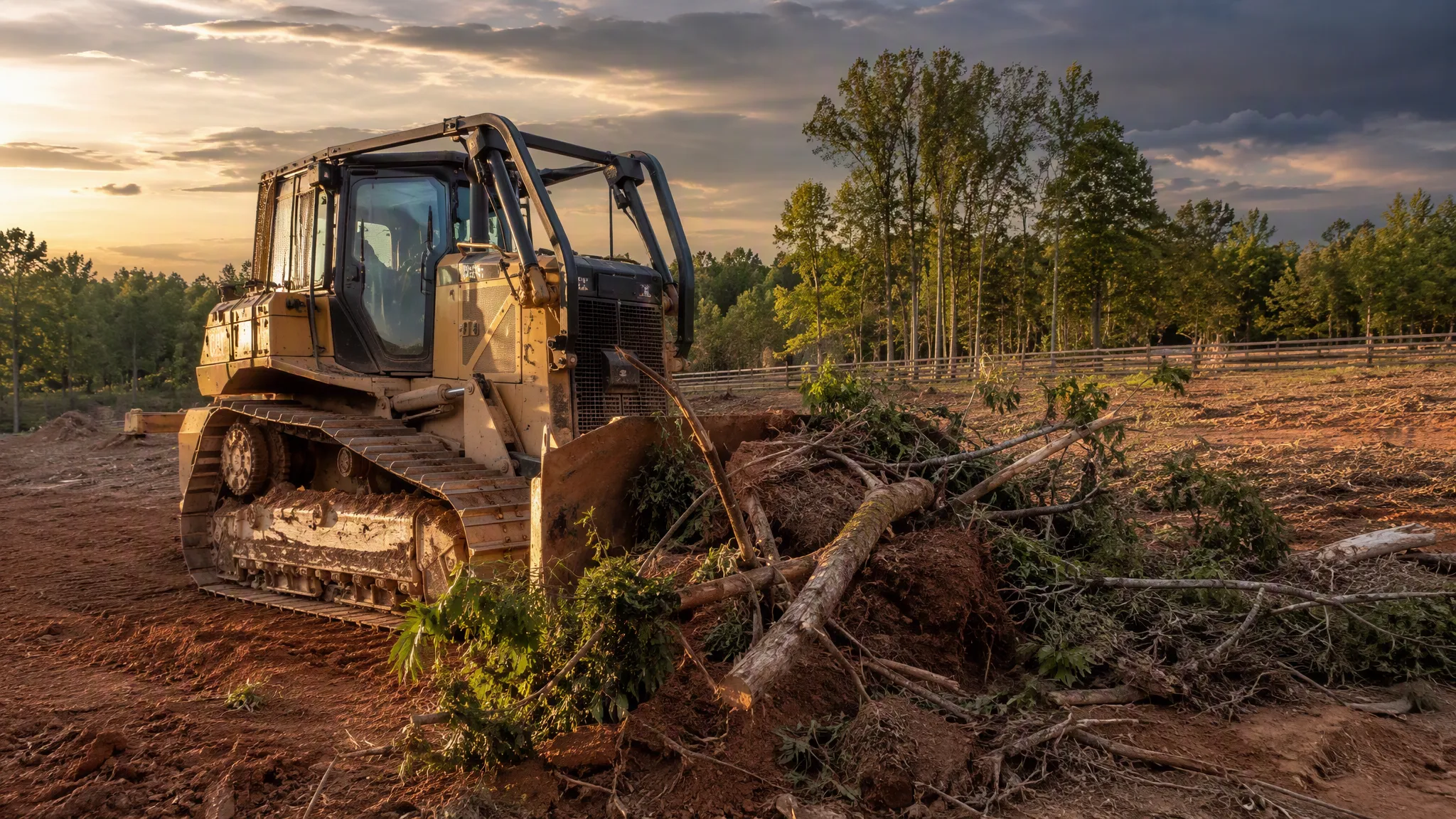
Sanford occupies a fascinating geographic and economic position in the Triangle’s extended orbit — it’s at the edge of the Sandhills region, where the Piedmont’s red clay transitions to the Coastal Plain’s sandy soils, and it’s experiencing genuine manufacturing and industrial growth after decades of mill town decline. Pfizer’s major manufacturing facility near Sanford and a growing industrial park ecosystem have created commercial site clearing demand that’s unusual for a town of its size. Meanwhile, Sanford’s rural Lee County surroundings offer the mix of timber tracts, agricultural land, and rural residential properties that define the clearing market in towns like this across central NC.
Sanford occupies a fascinating geographic and economic position in the Triangle’s extended orbit — it’s at the edge of the Sandhills region, where the Piedmont’s red clay transitions to the Coastal Plain’s sandy soils, and it’s experiencing genuine manufacturing and industrial growth after decades of mill town decline. Pfizer’s major manufacturing facility near Sanford and a growing industrial park ecosystem have created commercial site clearing demand that’s unusual for a town of its size. Meanwhile, Sanford’s rural Lee County surroundings offer the mix of timber tracts, agricultural land, and rural residential properties that define the clearing market in towns like this across central NC.
Sanford’s land clearing work splits between industrial/commercial site prep and rural residential clearing. The industrial park corridors along US-1, US-421, and NC-87 see periodic site prep for manufacturing and warehouse facilities — larger-scale clearing projects that require production capacity. Residential clearing is driven partly by Sanford’s own growth and partly by buyers from the Triangle purchasing rural Lee County acreage. Agricultural land in Lee County includes both active farms and transitioning parcels that former tobacco farmers have taken out of production, leaving fields that require clearing for new uses.
Sanford sits right at the Fall Line — the geologic boundary between the Piedmont’s crystalline rock soils and the Coastal Plain’s sedimentary sandy deposits. Properties west of Sanford tend toward Piedmont clay; properties east and south tilt toward sandier Sandhills soils (Candor, Wakulla series). This soil variability means Lee County properties can behave very differently during clearing: clay sites need compaction protection, sandy sites drain fast but erode easily when exposed. Forestry mulching adapts well to both — the mulch layer protects clay sites from compaction and sandy sites from wind and water erosion during the exposed clearing phase. The Sandhills’ native longleaf pine ecosystem, where it survives in Lee County, should be treated with particular care to avoid disrupting the wiregrass understory that the longleaf ecosystem depends on.
Sanford's growing industrial economy creates commercial site clearing demand; we handle large industrial-scale prep in Lee County's expanding corridors.
Lee County's Piedmont-to-Sandhills transition means soil variability that requires awareness of what you're working with before you start clearing.
Where longleaf pine habitat survives in Lee County, we approach clearing with awareness of its ecological significance and the value of preserving native wiregrass and native plant communities.
Former tobacco and timber land in Lee County is being converted to residential and industrial uses — we handle the clearing phase of that transition efficiently.
Sanford's main commercial arteries see regular site clearing activity; we're experienced working within NCDOT right-of-way rules on these highways.
Free quotes by phone, text or the form — most returned within one business day. Call 984-224-7995.