
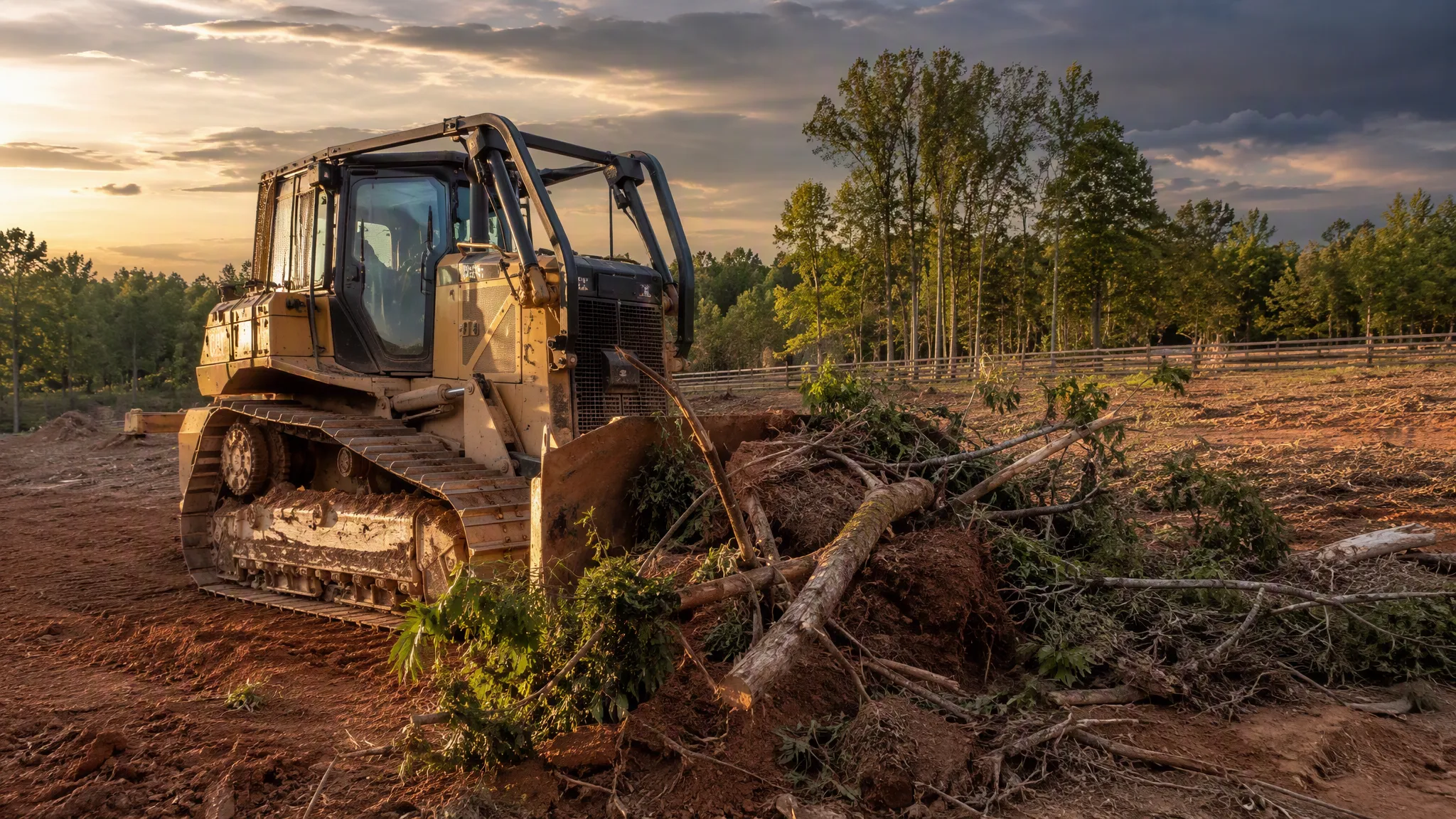
Smithfield is Johnston County — the county seat, the commercial hub, and the cultural heart of one of North Carolina’s most productive agricultural counties. Tobacco and hog farming defined this landscape for a century, and while the farming economy has shifted, the land itself still reflects that heritage: wide open fields transitioning back to scrub, abandoned tobacco barns surrounded by invading privet and cedar, pasture land sitting idle and reverting to woodland, and active farm operations needing brush management along fence lines and drainage ditches. Land clearing in Smithfield means understanding farm country — what the land was used for, where it’s going, and how to work it without destroying the soil that makes it valuable.
Smithfield is Johnston County — the county seat, the commercial hub, and the cultural heart of one of North Carolina’s most productive agricultural counties. Tobacco and hog farming defined this landscape for a century, and while the farming economy has shifted, the land itself still reflects that heritage: wide open fields transitioning back to scrub, abandoned tobacco barns surrounded by invading privet and cedar, pasture land sitting idle and reverting to woodland, and active farm operations needing brush management along fence lines and drainage ditches. Land clearing in Smithfield means understanding farm country — what the land was used for, where it’s going, and how to work it without destroying the soil that makes it valuable.
Smithfield’s clearing work spans the full agricultural-to-commercial spectrum. At one end, rural land owners need overgrown pasture reclaimed, abandoned fence lines cleared, and woodland edges pushed back from fields going back into production. At the other end, Smithfield’s role as a Johnston County commercial hub means commercial site clearing along US-70 Business, NC-210, and near the Johnston County Airport. Between those poles, rural residential buyers are building homes on former farm parcels and need homesites cleared from scrub-invaded former fields. The Neuse River flows directly through Smithfield, creating river-adjacent clearing needs that require special care.
Johnston County around Smithfield includes some of the state’s most productive agricultural soils — Goldsboro, Rains, and Lynchburg soil series dominate, all of which are sandy loam to fine sandy loam with moderate drainage. These soils are less prone to clay compaction than the red clay zones north of Clayton, but they are sensitive to erosion by water movement, particularly on the gently sloping terrain near the Neuse floodplain. Forestry mulching protects these productive soils by leaving organic matter in place rather than stripping the land bare. For farm properties reclaiming overgrown fields, the mulched material breaks down and adds organic matter back to soils that may have been cropped intensively for decades.
We work agricultural properties regularly — we understand farm infrastructure, drainage patterns, and how to clear around existing improvements without destroying them.
Johnston County has significant acreage of formerly active farmland going to scrub; we reclaim these areas efficiently and leave them ready for re-use.
Former tobacco ground often has specific soil and drainage characteristics; we clear and manage these properties with awareness of their agricultural history.
The Neuse flows through Smithfield's heart — river-adjacent properties require buffer compliance, and we work within state rules.
Light industrial and commercial clearing near the airport and along US-70 is part of our regular Johnston County work.
Free quotes by phone, text or the form — most returned within one business day. Call 984-224-7995.