
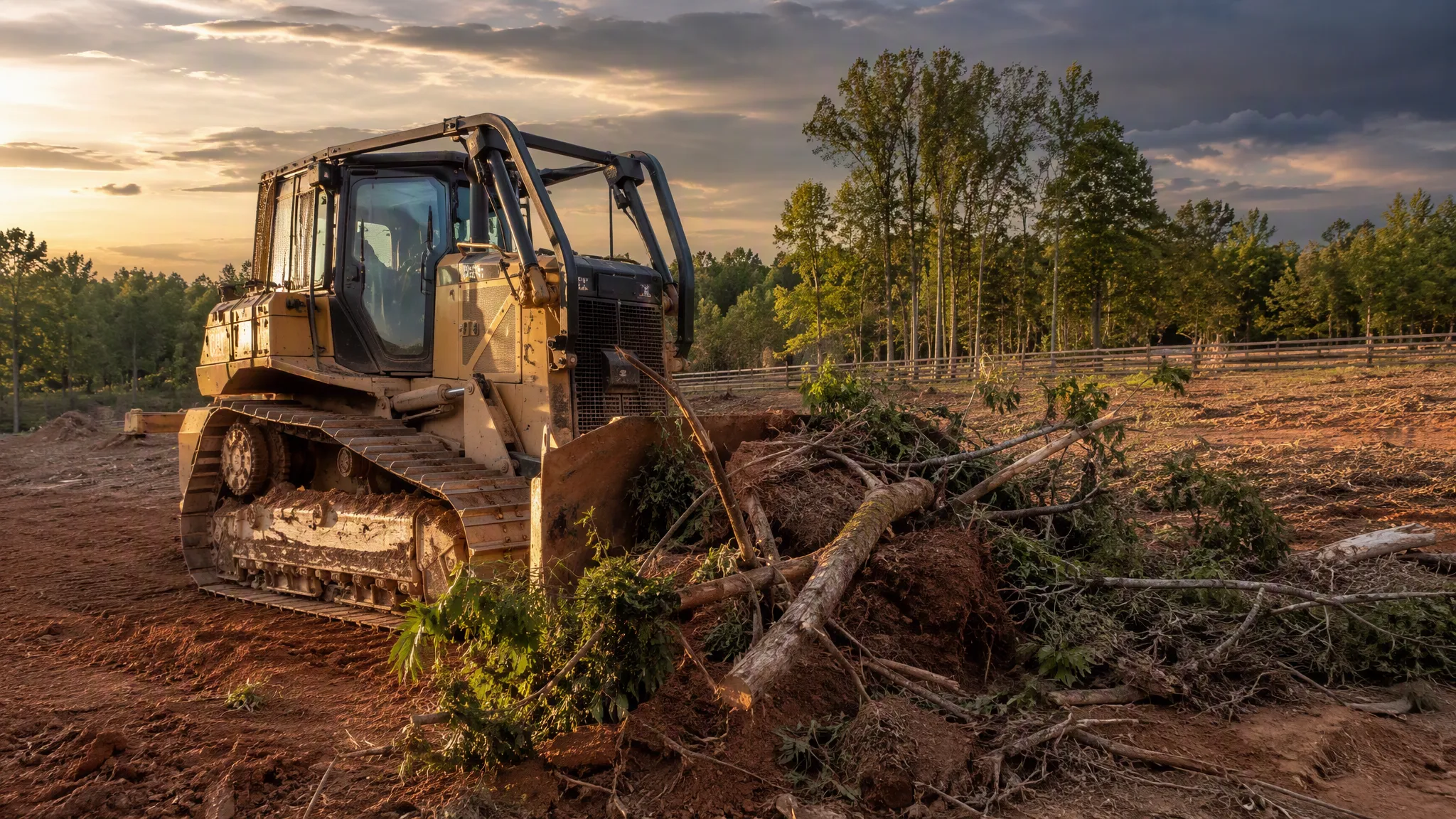
Clayton sits at the exact point where Raleigh’s suburban expansion collides with Johnston County’s rural identity — and the land clearing work that results from that collision is some of the most interesting and challenging in the region. Raleigh commuters buying in Clayton are moving into developments carved out of former soybean fields and pine timber tracts. The underlying Johnston County soil is notoriously red-clay heavy, sticky when wet, and prone to rutting and erosion when disturbed. Getting clearing right in Clayton means understanding that the ground itself is going to fight back if you don’t approach it correctly.
Clayton sits at the exact point where Raleigh’s suburban expansion collides with Johnston County’s rural identity — and the land clearing work that results from that collision is some of the most interesting and challenging in the region. Raleigh commuters buying in Clayton are moving into developments carved out of former soybean fields and pine timber tracts. The underlying Johnston County soil is notoriously red-clay heavy, sticky when wet, and prone to rutting and erosion when disturbed. Getting clearing right in Clayton means understanding that the ground itself is going to fight back if you don’t approach it correctly.
Clayton’s land clearing market is driven by residential subdivision development along the US-70 Business corridor, NC-42, and the Holt Road / Amelia Church Road growth zone pushing out from town center. Johnston County’s agricultural legacy means many of the tracts being cleared were active in row crops or timber within the last decade — they tend to have better internal drainage infrastructure (ditch systems, farm roads) than pure woodland tracts, but they also have established hedgerows and woodlot remnants that require systematic clearing. Commercial clearing along US-70 and at the I-95/US-70 interchange area adds industrial and retail site prep to the mix.
Johnston County’s Cecil and Appling soil series — the red, iron-rich clay soils that stain everything they touch — are notoriously susceptible to compaction under heavy equipment. When conventional clearing equipment drives repeatedly across wet red clay, the result is a compacted hardpan that becomes a drainage and landscaping problem for years afterward. Forestry mulching’s lower-ground-pressure approach, combined with leaving the mulch layer to protect the soil surface, dramatically reduces compaction risk. On sloped lots draining toward the Neuse River (which flows through Johnston County), the erosion protection mulching provides is especially important under state stormwater rules.
We understand how to work Johnston County's heavy clay soils without creating the compaction and drainage problems that follow bad clearing work.
Clayton's builder market moves fast; we match subdivision production schedules and keep lots cleared ahead of framing crews.
The Neuse River flows through Johnston County with enforceable riparian buffer rules; we clear to the edge without triggering DWR violations.
Industrial and commercial site prep along Clayton's primary commercial corridor requires understanding of NCDOT right-of-way rules and driveway permit requirements.
Johnston County's farm hedgerows — often multi-row windbreaks of loblolly pine and sweetgum — require systematic clearing that a single machine working strategically can handle efficiently.
Free quotes by phone, text or the form — most returned within one business day. Call 984-224-7995.